


Testicular torsion
Key facts
- Testicular torsion happens when your testicle twists around the spermatic cord, cutting off the blood supply to your testicle.
- Symptoms of testicular torsion include severe pain and swelling in your scrotum.
- Testicular torsion needs emergency surgery to prevent permanent damage to your testicle.
- During surgery, your testicle is untwisted and stitched in place so it can't twist again in the future.
- Testicular torsion is most common in teenagers, but it can occur at any age.
What is testicular torsion?
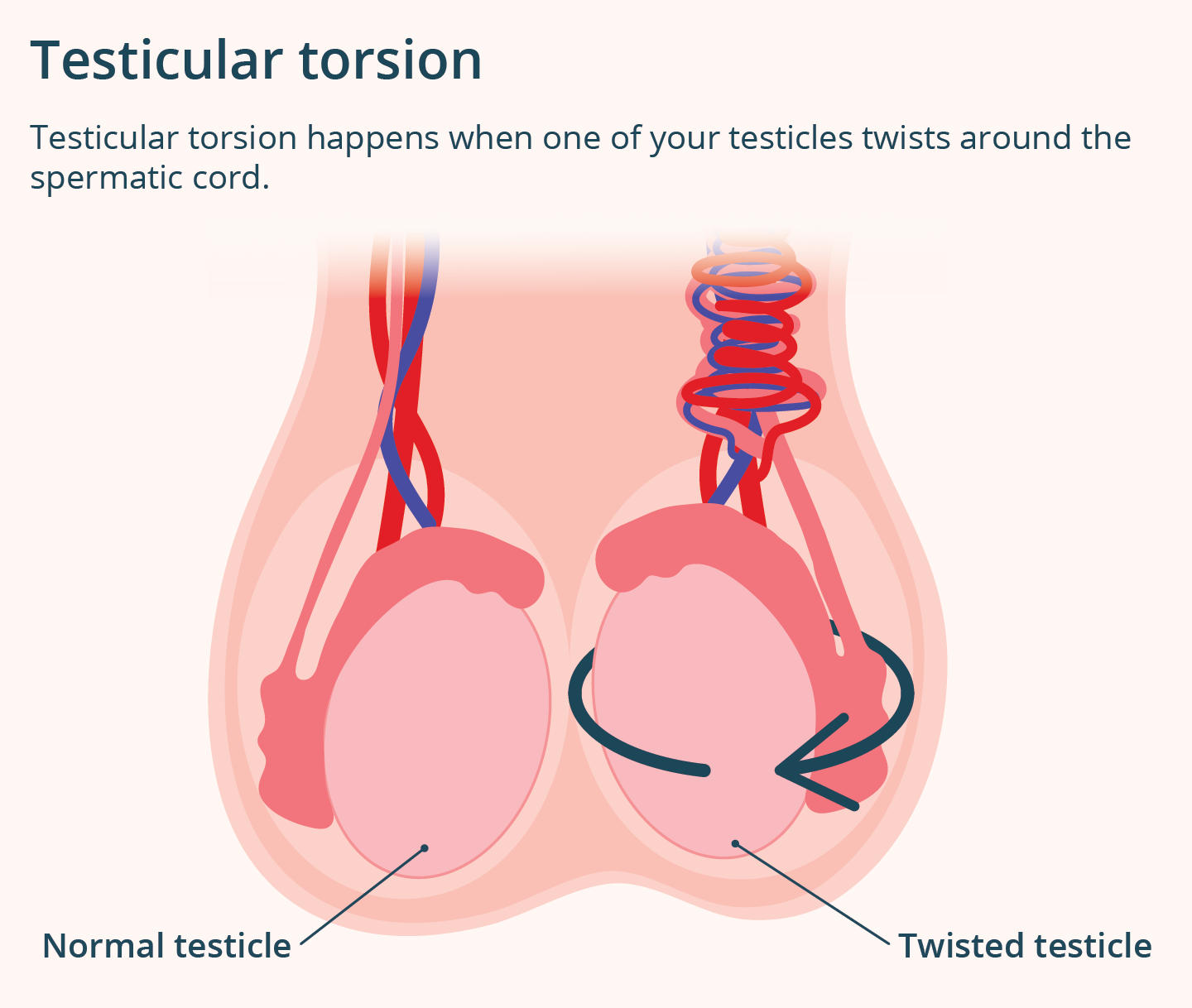
Testicular torsion happens when one of your testicles twists around the spermatic cord.
Each testicle is attached to a spermatic cord. This contains blood vessels that carry blood to the testicle. If this cord becomes twisted it blocks the flow of blood to the testicle, causing testicular torsion.
Testicular torsion is an emergency. If the blood supply is cut off for too long, your testicle can be permanently damaged.
Testicular torsion is most common in teenage males, but it can occur at any age.
What are the symptoms of testicular torsion?
Symptoms of testicular torsion include:
- sudden and severe pain in your scrotum
- swelling and redness of your scrotum
- nausea or vomiting
- pain in your lower abdomen (tummy) or thigh
- one testicle being higher than normal
- difficulty walking
Sometimes, testicular torsion causes sudden pain that goes away without treatment. This happens when your testicle twists and then untwists on its own. If this occurs, see a doctor as soon as possible. You may need surgery to prevent it happening again.
CHECK YOUR SYMPTOMS — Use the Symptom Checker and find out if you need to seek medical help.
When should I go to the emergency department?
You should go to the emergency department if you have any symptoms of testicular torsion.
Testicular torsion is an emergency and requires surgery within a few hours.
FIND A HEALTH SERVICE — The Service Finder can help you find doctors, pharmacies, hospitals and other health services.
What causes testicular torsion?
Often there is no known cause of testicular torsion.
Testicular torsion is more likely if:
- you are going through puberty
- you have undescended testicles
- you have had a recent injury to your scrotum
- you have an anatomical difference of your scrotum
How is testicular torsion diagnosed?
To diagnose testicular torsion, your doctor will need to examine your scrotum. This might feel embarrassing and awkward, but it's very important.
There is usually no need for any tests. You might have an ultrasound of your scrotum or abdomen if it's not clear what is causing the pain.
How is testicular torsion treated?
Testicular torsion is usually treated with surgery. To help prevent permanent damage to your testicle, surgery should be done within 6 hours from when the pain started. This surgery is called an orchiopexy.
During the operation, the surgeon will make a small cut in your scrotum and untwist your testicle. They will then stitch your testicle to the inside of your scrotum to prevent it from twisting again. The surgeon might stitch your other testicle in place too.
You will need to have a general anaesthetic. Your doctor will tell you when you can return to normal activities after the surgery.
What are the complications of testicular torsion?
If it's not treated quickly, testicular torsion can cause your testicle to be permanently damaged or die. This can lead to:
- infection
- fertility problems
- changes in the appearance of your scrotum
- slower development during puberty
If your testicle has died, you will need to have an operation to remove it.
Can testicular torsion be prevented?
For most people, there is no way to prevent testicular torsion.
If you have undescended testicles, you may need an operation to bring your testicles down and fix them in the scrotum. This can help prevent problems such as testicular torsion in the future.
Resources and support
Visit Healthy Male to learn more about your testicles.
The Emergency Care Institute provides information on the symptoms and management of testicular torsion.
You can also call the healthdirect helpline on 1800 022 222 (known as NURSE-ON-CALL in Victoria). A registered nurse is available to speak with you 24 hours a day, 7 days a week.
Learn more here about the development and quality assurance of healthdirect content.
Last reviewed: September 2025


