
Breast augmentation (breast implants)
Key facts
- Breast augmentation is a form of cosmetic surgery to give you larger breasts.
- The procedure involves placing silicone or saline implants behind your breasts.
- Breast implants may need to be replaced after 10 to 15 years.
- Ask your doctor about the risks and benefits of breast implants.
What is breast augmentation?
Breast augmentation is a form of cosmetic surgery that may change your appearance by giving you larger breasts. It can also be called a breast enlargement or breast reconstruction.
Some people have breast implants as part of reconstruction surgery after a mastectomy (breast cancer surgery). This page is about breast surgery for cosmetic reasons.
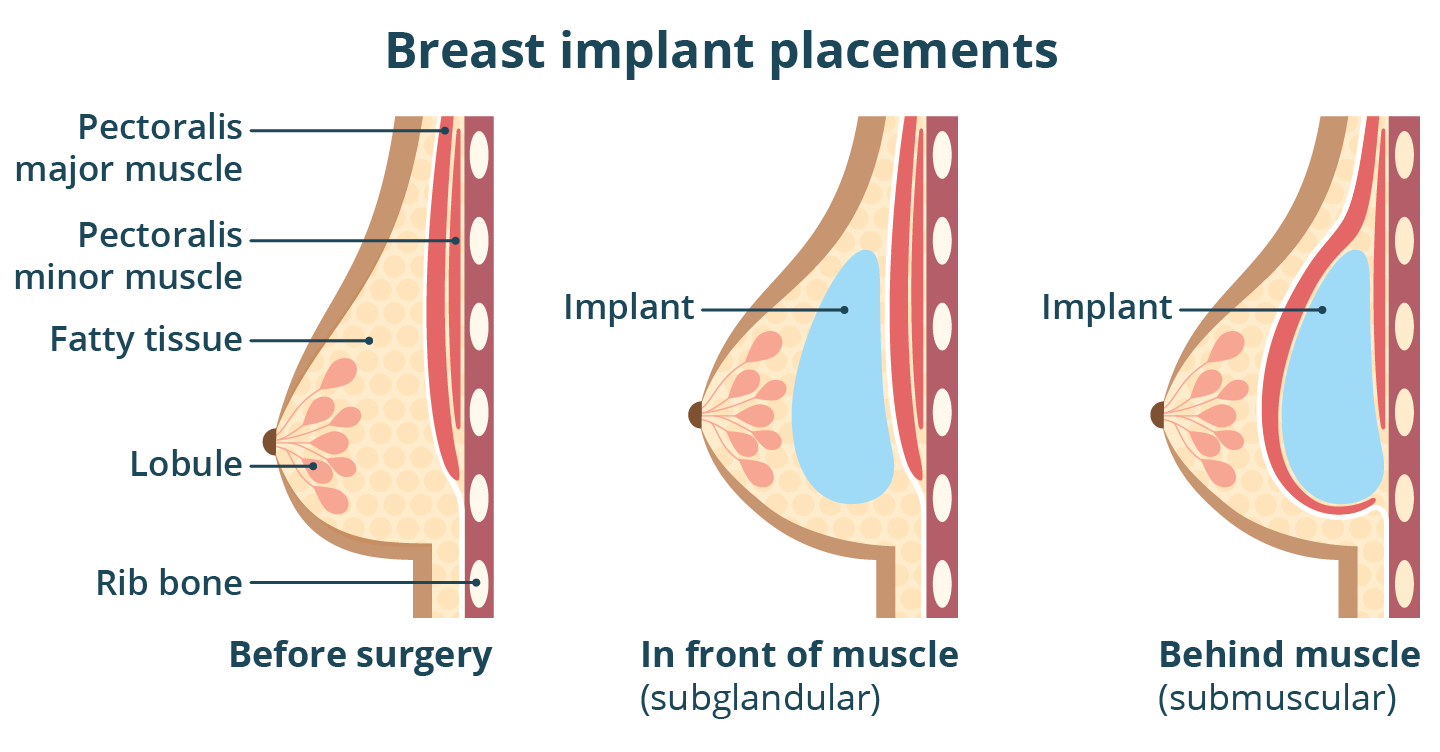
A breast augmentation involves placing implants under your breasts or under the breast muscles on your chest. The implants are made from a silicone shell filled with either saline (salty water) or silicone (rubber-like) gel.
Some cosmetic surgeons offer fat grafting, where fat is moved from another part of your body (such as your buttocks) to your breasts.
Following a review by the Therapeutic Goods Administration (TGA), some breast implants have been removed from the Australian market, or had certain conditions placed on them.
More information is available on the TGA website.
What are the benefits of breast augmentation?
You may consider breast augmentation for many reasons. You may want to feel more physically attractive or better about yourself.
What should I consider before choosing to have breast augmentation?
Society places pressure on people to have a certain body shape or appearance. You may be feeling unhappy with your body shape. However, here are some things to consider before deciding to have breast augmentation:
- Breast implants do not last for life and usually need to be replaced after 10 to 15 years.
- There have been rare cases where cancer grows in the fluid (liquid) and scar tissue around a breast implant.
- Some people find that after surgery their breasts do not look how they hoped.
- Breast implants can make it harder to detect breast cancer during screening checks.
- There may be changes to your ability to breastfeed after surgery.
What does a breast augmentation procedure involve?
You will most likely need a general anaesthetic so that you are asleep during the operation.
The surgeon will make a cut alongside your breast, then place the implants between the breast tissue and the muscle, or behind the large chest muscle under the breast. Your doctor will decide which method is right for you.
There are different ways to do the operation. The method chosen by your surgeon can affect how long it takes you to recover.
How can I prepare myself for a breast augmentation?
If you decide to go ahead, get as much information about the procedure as possible.
Before surgery you can prepare by:
- being physically fit to help the recovery process
- having a healthy body weight
- trying to quit smoking
- asking your doctor if you need to change any of your medications
- telling your surgeon about any health conditions or allergies
- asking if you will be staying overnight or recovering at home
Choosing a surgeon
If you are thinking about breast augmentation, it is important to choose your surgeon carefully. Find someone who you feel comfortable with, and who will speak to you honestly about the benefits and risks.
Your general practitioner (GP) will need to make the referral to the surgeon you choose, and they can help you decide.
The Australian Health Practitioner Regulation Agency (AHPRA) has a register of medical practitioners. You can check this register to make sure your surgeon is a Fellow of the Royal Australasian College of Surgeons (RACS). You can also check if the surgeon has had any serious disciplinary action taken against them.
Cost of breast augmentation
Generally, Medicare does not cover the cost of cosmetic surgery. If you have private insurance, check with your policy to see if it will cover cosmetic surgery.
The cost of a breast augmentation varies from patient to patient and includes:
- surgeon's fees
- anaesthetist's fees
- clinic or hospital fees
- the implants
- medication, dressings and support garments
You should discuss all fees with your surgeon before the procedure.
Questions to ask before surgery
There is a lot to consider before deciding to have cosmetic surgery. You can ask your doctor questions about:
- surgery in general
- breast augmentation
Some questions that you may want to ask about breast augmentation are:
- What type of breast implants do you recommend and why?
- Will I lose any sensation (feeling) after having implants?
- How will the surgery change the position and appearance of my nipples?
- How much bruising, swelling or pain will I get? What can I do about this?
You can also ask questions about possible long-term complications of the procedure such as:
- How long will the implants last?
- Will I be able to breastfeed in the future?
- How many of your patients have had a ruptured (burst) or failed implant? What will this mean for me if this happens?
- How likely am I to need further operations because of problems?
- If I need more surgery due to complications or if I am not happy with the result, will there be extra costs?
ASK YOUR DOCTOR — Preparing for an appointment? Use the Question Builder for general tips on what to ask your GP or specialist.
How soon will I recover?
Recovery depends on your health before surgery and your surgeon's recommendations. They may ask you to take a week off work and avoid moderate exercise (exercise that feels a bit difficult) for 5 weeks.
You might have:
- tubes in place to drain blood and other fluids away from your chest
- dressings applied to your surgery sites
- a compression bandage to help reduce swelling
- some pain and discomfort from the swelling and bruising around your chest
If you are experiencing fever, severe pain, nausea or vomiting during your recovery, contact your surgeon or go to a hospital emergency department.
To help you manage the recovery, you may need:
- pain relief medicines
- to wear extra support for a few weeks until your breasts heal
- to take some time off work
- extra help with daily activities
- to return to the hospital or to see the surgeon for a follow-up appointment
What complications can happen?
Like any surgery, breast implant surgery comes with risks. You should discuss the risks in detail with your surgeon.
Some of the possible problems include:
- bleeding, or a collection of blood (haematoma)
- infection
- changes to the feeling in the breast skin or nipple, including numbness
- swelling or collection of fluid around the breast
- injury to surrounding tissue
- rupture (leak)
There are other rare but serious risks to consider including:
- an allergic reaction to the anaesthetic
- blood clots in your legs, which can travel to the lungs and cause serious illness
- breast implant-associated cancer (implants linked with cancer in the past are no longer available)
If you or someone else is having trouble breathing or has severe chest pain, call triple-zero (000) and ask for an ambulance.
You should consider that you may need another operation. The longer you have breast implants, the more likely you are to have problems.
If you have your implants removed but not replaced, your breasts might be scarred or dimpled (marked).
When should I see my doctor?
If you have any of these symptoms, contact your surgeon straight away:
- high temperature (over 38°C) or chills
- nausea, vomiting, shortness of breath or diarrhoea
- heavy bleeding from the surgery site
- leakage of blood or fluid that happens more than one day after surgery
- worsening or spreading redness around the implant area
- increasing pain or tenderness in your breasts
If you are experiencing fever, vomiting, heavy bleeding or other symptoms that concern you after your surgery, contact your surgeon or go to your nearest hospital.
FIND A HEALTH SERVICE — The Service Finder can help you find doctors, pharmacies, hospitals and other health services.
Are there alternatives to breast augmentation?
Breast augmentation may not be right for you. Some alternatives are:
- counselling to help you accept your body shape
- wearing a padded bra
- other types of surgery that do not involve implants
Resources and support
If you are considering a breast augmentation, you should first discuss it with your doctor. More information is also available on the Australian Society of Plastic Surgeons and the Agency for Clinical Innovation websites.
The Australian government has a fact sheet on cosmetic surgery available online.
Use the Therapeutic Goods Administration's guide on what to ask before getting a medical implant, available in many community languages.
You can also call the Healthdirect helpline on 1800 022 222 (known as NURSE-ON-CALL in Victoria). A registered nurse is available to speak with 24 hours a day, 7 days a week.
Learn more here about the development and quality assurance of healthdirect content.
Last reviewed: November 2025